
 Across Europe, democracy and human rights are facing growing pressure. Cities are increasingly at the forefront of responding to these challenges, translating rights into policies, services and everyday realities for their residents.
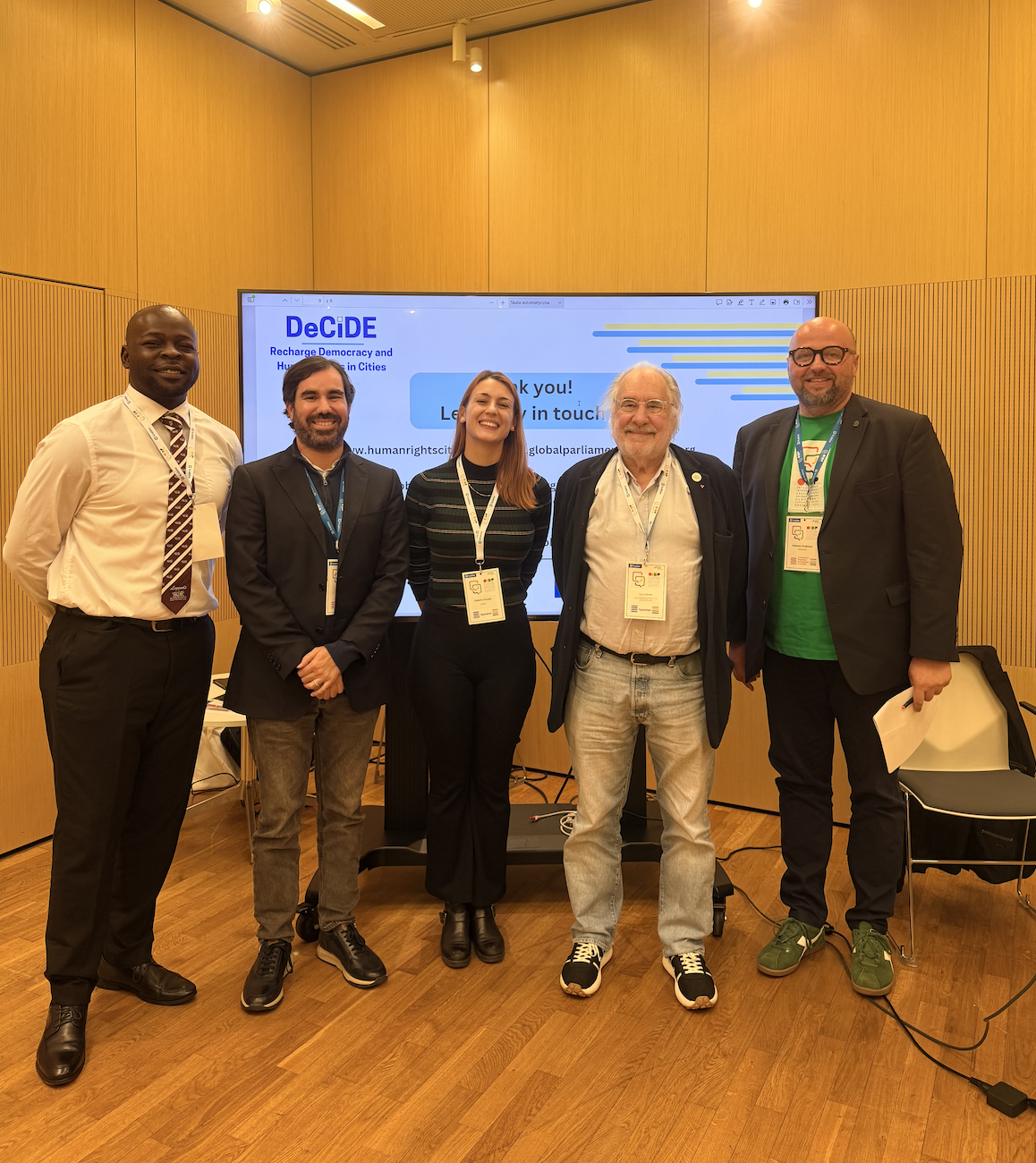
On the 22nd of September 2026, at the OIDP Conference at ICE Kraków, the Global Parliament of Mayors and the Human Rights Cities Network hosted “Monitoring Rights, Building Trust: Co-Creating a Standardised Human Rights Monitoring System with EU Cities”, marking an important milestone in the DeCiDE project.
Over the course of the project, eight pilot cities, Braga, Chișinău, Ghent, The Hague, Józsefváros (Budapest), Kraków, Padua and Benalmádena, worked together to develop and test a Standardised Monitoring System (SMS) for human rights. The process was designed not simply to measure municipal activities, but to help cities understand whether their policies are producing meaningful change in people’s lives.
The discussion in Kraków brought that work from methodology to practice.
Prof. Eric Corijn ( Urban Studies at Brussels University and Director Policy & Research of GPM) set the scene in a first keynote. He documented how in many countries in Europe and the EU in itself democracy is at stake. In each case Human Rights and the State of Law is under attack. Cities are resisting, because a city is not a country, is based on exchange and diversity, needs tolerance and conviviality. That is why urban democracy has to be deepened and extended and monitoring the effects of policies must be measured.
Marshall Wanimo, Project Coordinator of DeCiDE at the Human Rights Cities Network, presented the development of the monitoring framework, including 9 core human rights indicators co-created with participating cities. The process moved from selecting priority human rights areas and building monitoring capacity to validating indicators, designing monitoring tools and collecting baseline data.
Mateusz Płoskonka, Deputy Director at Kraków City Hall, reflected on Kraków’s experience of building a shared understanding of indicators between the municipality and civil society. Rather than imposing a methodology, the process created space for co-creation and strengthened shared responsibility for monitoring human rights locally.
Federica Faraoni of COSEP shared lessons from Padua, highlighting the realities faced by frontline social services and the importance of embedding monitoring into the way municipalities and civil society organisations work together. A key lesson was clear: effective monitoring needs to be recognised and resourced as an integral part of service delivery.
Adriá Duarte of UCLG placed these experiences within the wider process of localising human rights. His contribution highlighted the role of local governments and city networks in translating universal rights into concrete policies and services, as well as the growing importance of cooperation across cities in the current European context.
The session concluded with reflections from Prof. Eric Corijn. He stressed the connection between the demise of welfarism, the growth of the extreme right and the authoritarian tendencies. Cities have a distinctive role in defending democracy and human rights.
His closing message was a reminder that human rights cannot be taken for granted. They require institutions, evidence, cooperation and continued commitment.
This is precisely why monitoring matters.
By creating locally owned, evidence and rights-based monitoring systems, cities can better understand where progress is being made, where gaps remain and where action is needed. The DeCiDE experience also demonstrates the value of peer learning and offers a potential benchmark for other Human Rights Cities. Because protecting rights begins with being able to see whether they are being realised.
Thank you to all our speakers, partners, the OIDP Conference and especially the eight DeCiDE pilot cities for contributing their knowledge and experience.